

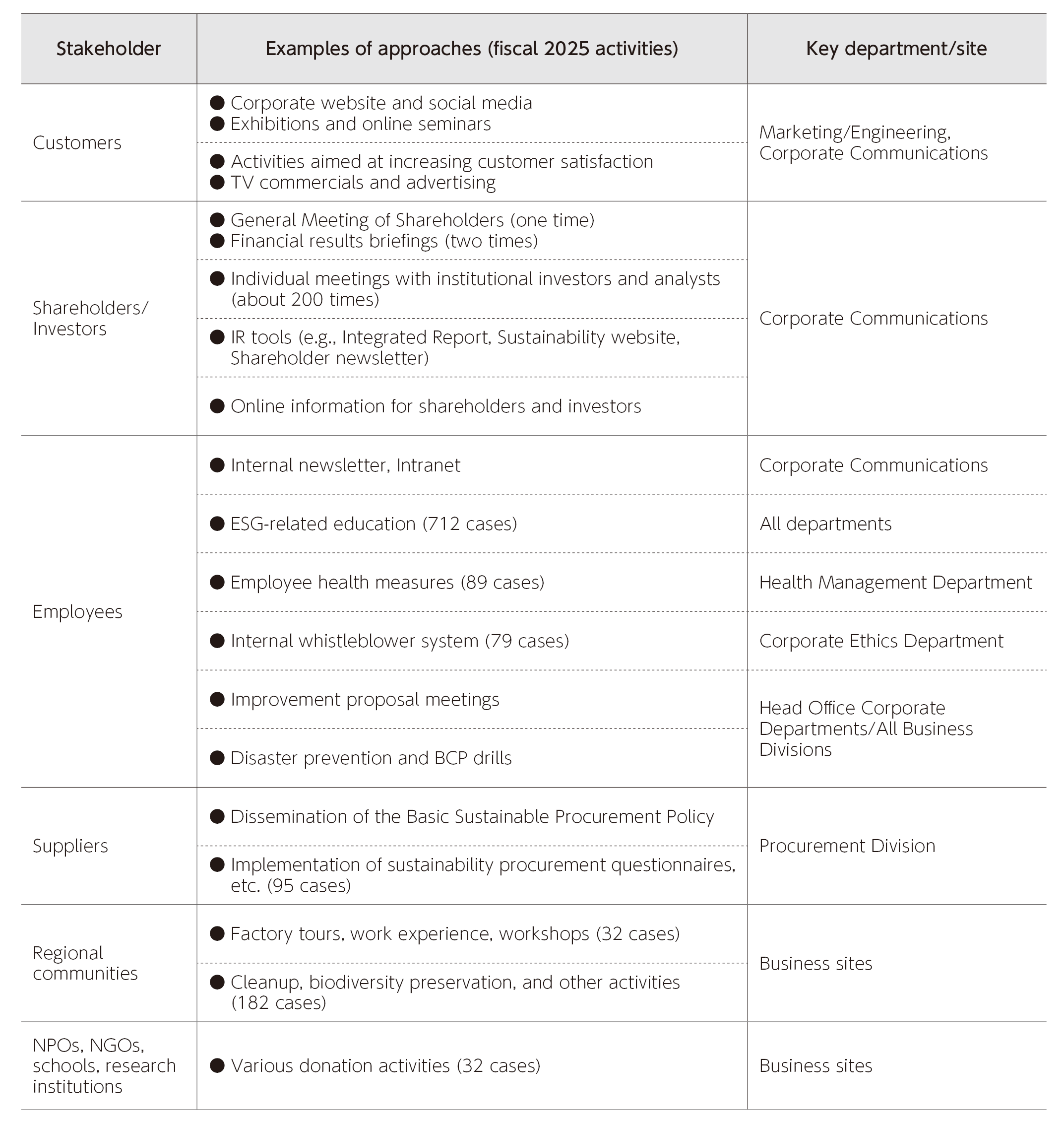
The Nisshinbo Group believes that only by listening to customers, stockholders, employees, and the other stakeholders involved with the Group as stipulated in VALUE and gaining their understanding and trust will the Group be able to achieve sustainable growth and enhance its corporate value over the medium to long term. The Group takes a variety of opportunities to deepen communication with all stakeholders and works to resolve issues.
The Nisshinbo Holdings' Basic Policy on Communication with stakeholders is stipulated in "Nisshinbo Corporate Governance Policy" III-1-(1).
Stakeholder Engagement Initiatives
Third-Party Opinion
Continuing to meet the expectations and needs of the Nisshinbo Group's stakeholders, the Group received feedback from outside experts regarding their assessment of the Nisshinbo Group's sustainability efforts, as well as their expectations and requests of the Group.
Takeshi Shimotaya
Managing Director, Sustainavision Ltd.
I hereby express my opinion as a third party about the Nisshinbo Group's sustainability initiatives based on the information provided in the Nisshinbo Group Sustainability website and related reports. Please note that my opinion is based on the 2026 Sustainability Disclosure Materials shared with me.
Under the "6th Sustainability Promotion Plan (FY2025-2027) ", which began in FY2025, the Nisshinbo Group is steadily advancing initiatives in the environmental, social, and governance (ESG) domains by putting its corporate philosophy of "Change and Challenge! For the creation of the future of Earth and People" into practice. Building on the initiatives of the previous period, the plan has evolved to be more results-oriented by featuring higher KPIs and expanded goals in the social sector.
From an environmental perspective, the Nisshinbo Group deserves high praise for reducing its Scope 1 and 2 greenhouse gas emissions by 57% compared to FY2014, thereby achieving its FY2027 target ahead of schedule. Concrete achievements toward decarbonization are also evident, such as the switch to 100% renewable energy for electricity consumption at the Tokyo Works of KOKUSAI DENKI Electric Inc. and the increased purchase of renewable energy at multiple locations. Furthermore, the proportion of electricity derived from renewable energy sources rose from 16% in FY2024 to approximately 19% in FY2025, indicating that progress is being made in the area of renewable energy utilization, which was identified as a challenge during the last fiscal year. Furthermore, the Nisshinbo Group reported the achievement of its FY2027 targets for multiple environmental metrics and KPIs, including water consumption per unit of sales, energy consumption, and emissions of PRTR-listed substances, which indicate that its ongoing efforts to reduce environmental impact are steadily yielding results.
On the other hand, Scope 3 emissions increased in FY2025 compared to the previous year with improved data collection accuracy at overseas locations cited as the primary factor. While this improvement in calculation accuracy represents significant progress, expectations for the company are to strengthen substantive reduction measures across the entire value chain and to disclose progress on these measures in a transparent manner. Furthermore, while there are signs of improvement regarding products that contribute to the development of the sustainable society and the promotion of LCA, providing clearer explanations of the definitions of target products, evaluation criteria, and the specific contributions made by each business segment are desirable in order to achieve these goals.
On the social front, the human rights due diligence initiatives of the Nisshinbo Group are entering a new phase. In FY2025, the Group focused on establishing and strengthening its grievance mechanisms and conducting surveys of Group companies in both Japan and overseas to identify current challenges. In particular, the extent to which these surveys are being conducted with reference to the requirements for effective grievance mechanisms outlined in Principle 31 of the UN Guiding Principles on Business and Human Rights and the assessment criteria of the Corporate Human Rights Benchmark (CHRB) demonstrates the commitment to advancing these efforts in line with international standards. The fact that the Nisshinbo Group has candidly identified areas for improvement, such as multilingual support, raising awareness among external stakeholders, publicizing response procedures, and codifying anti-retaliation provisions, can be viewed as an important step toward enhancing the effectiveness of these measures in the future.
In the area of human capital, quantitative progress has been demonstrated through such metrics as the proportion of female managers, the proportion of managers recruited from outside the company, and the rate of succession planning, and initiatives to promote the active participation of a diverse workforce are advancing. Furthermore, initiatives related to work-style reform and health management, such as a 100% parental leave uptake rate among male employees, an increase in the rate of follow-up examinations following regular health checkups, and the provision of health guidance to high-risk individuals, are also being implemented with tangible results. On the other hand, regarding employee engagement, while we can commend the high participation rate with 19,830 employees from 81 Nisshinbo Group companies in both Japan and overseas participating, resulting in a response rate of approximately 92.3%, we must pay close attention to the decline in the percentage of employees who affirm their commitment to putting the corporate philosophy, VALUE, and the Code of Conduct into practice. While considering the impact of changes in survey methodology, it is important to continue interactive outreach initiatives and on-site improvement activities, especially as business restructuring progresses, so that each employee can connect the corporate philosophy to their daily work and put it into practice as a personal commitment.
For the Nisshinbo Group’s supply chain, I believe it is a significant step forward that the Group conducted a survey using uniform criteria for both domestic and overseas suppliers in accordance with its Basic Policy on Sustainable Procurement and Sustainable Procurement Guidelines, which achieved a high response rate of 95% overall. I believe this will serve as a crucial foundation for expanding the sustainable procurement initiatives beyond Japan to all overseas locations and the global supply chain. Going forward, I believe that by supplementing the Nisshinbo Group’s surveys with mechanisms for in-depth assessments focused on high-risk sectors, regions, and raw materials, as well as requests for improvement, corrective support, and progress monitoring, the Nisshinbo Group will ensure that sustainability initiatives have a more tangible impact across the entire supply chain.
In terms of governance, Nisshinbo has updated its implementation framework by considering organizational restructuring to address compliance training, the operation of the corporate ethics reporting system, risk management, information security, disaster risk response, and internal controls, which further demonstrate the commitment to integrating sustainability issues into management practices. Going forward, the connection between supervisory and executive functions is expected to be clarified by establishing a more explicit link between the content reported to the Board of Management and the Board of Directors and the targets and KPIs outlined in the sustainability promotion plan.
Overall, in FY2025, the first year of the 6th Sustainability Promotion Plan, the Nisshinbo Group demonstrated steady progress in the areas of environmental impact reduction, respect for human rights, human capital, supply chain management, and compliance. Moving forward, I look forward to the Nisshinbo Group setting even higher goals for items where targets have already been met while also advancing more concrete measures and disclosing results regarding Scope 3 emissions reductions, the expansion of sustainable products, the advancement of LCA, improving the effectiveness of human rights remedy mechanisms, enhancing employee engagement, and addressing risks within the supply chain. Through these initiatives, I look forward to seeing the Nisshinbo Group as a corporate group that shapes the future of the planet and its people through its business activities further advance its efforts toward the realization of a sustainable society.
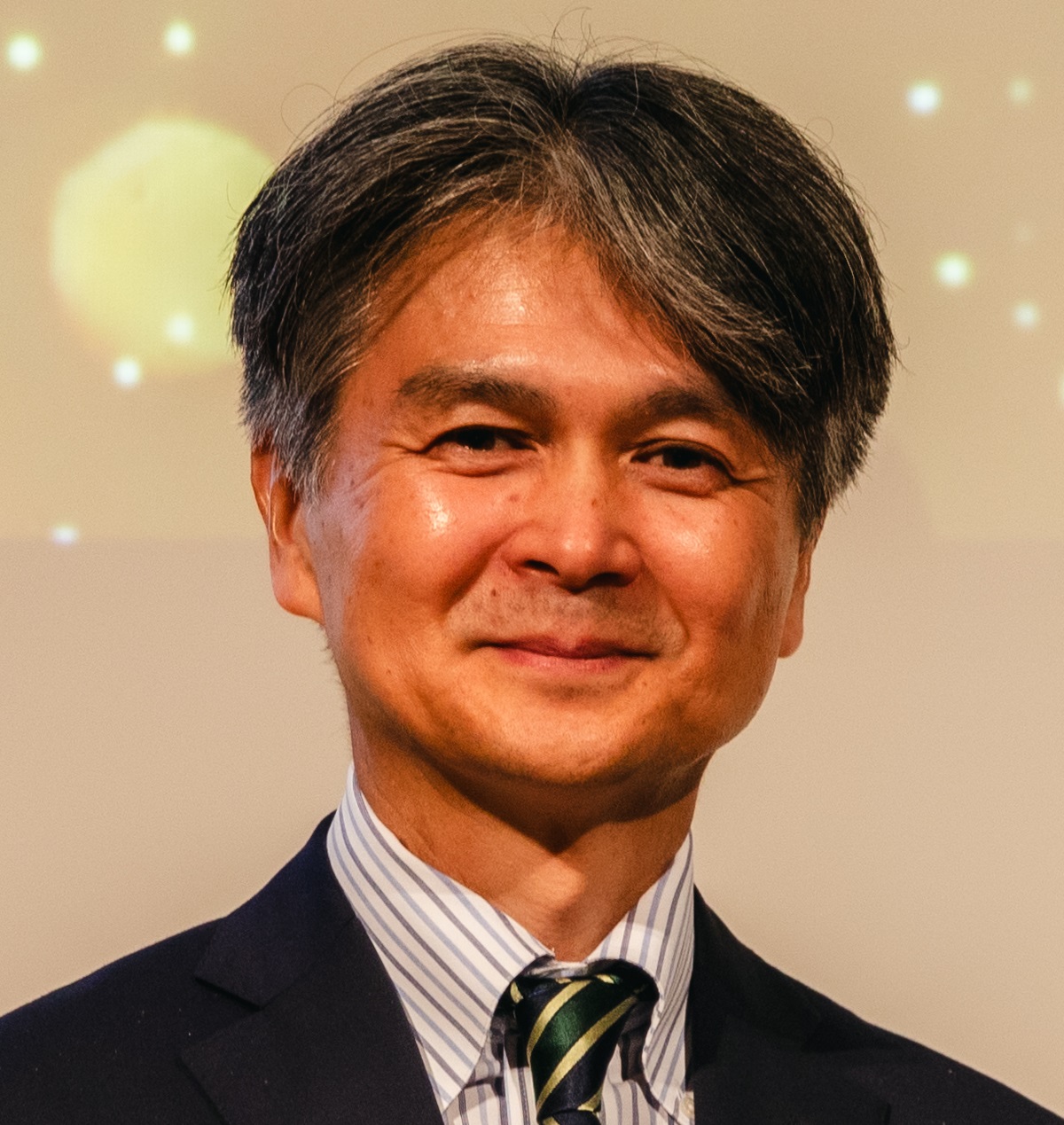
Takeshi Shimotaya
Managing Director, Sustainavision Ltd.
Joined Kawasaki Heavy Industries, Ltd. in 1991 and was responsible for human resources, general affairs, recruitment, training, payroll, labor negotiations, occupational health and safety, etc. in the Factory Management Department of the Division Handling Environmental Machinery. After being involved in setting up a new business in the environmental sector (new energy and R.P.F. manufacturing), moved to the UK in 2007. Holds a Master of Environmental Science from the University of East Anglia, UK, and an MBA from Lancaster University, UK. In 2010, he established Sustainavision Ltd. in the UK to serve as a sustainability bridge between Japan and Europe.
Based in London, Sustainavision Ltd. provides consulting services, training, seminars, and related research to Japanese companies on the topics of sustainability management, ESG, business and human rights, and supply chain management. In addition, the company has regularly provided training courses for the UK CMI-certified Sustainability (CSR/ESG) Practitioner qualification since 2012. By providing practical learning opportunities for integrating sustainability into corporate management, the company has demonstrated its commitment to developing sustainability talent in Japan. Currently, taking into account differences in the status of sustainability initiatives across industries, Sustainavision is also focusing on supporting sectors where accelerated action is particularly needed.
Founder, The Global Alliance for Sustainable Supply Chain.
President, Japan Sustainable Restaurant Association
Global Sustainable Tourism Council(GSTC)Food & Beverage Advisory Board Member
Chair of the Working Group on Promoting Sustainable Restaurants, Public-Private Council on Food Tech, Ministry of Agriculture, Forestry and Fisheries