

Research and Development
From Integration to Execution—Advancing Our Research and Development Structure to Accelerate New Business Creation
Creating new businesses is essential to the sustainable growth of the Nisshinbo Group. In April 2025, we integrated our research organizations in the electronics field and established the Future Innovation Division (FI Division). In fiscal 2026, we will evolve our business creation activities into a new Integrated Three-Party Framework that integrates R&D, business units, and frontline operations, enabling us to translate research outcomes into business value more reliably and rapidly. At the same time, we will concentrate our research themes on the key growth areas of the Wireless and Communications business and introduce a new R&D management framework built around our Long-Term Technology Plan, thereby accelerating research and development that leads directly to business growth.
Purpose of the Future Innovation Division
■ From Organizational Integration to the New Business Creation Phase
The FI Division was established by integrating the Group’s previously dispersed research organizations in the electronics field into a single organization dedicated to shaping the future of the Nisshinbo Group. During fiscal 2025, we completed the organizational integration as the foundation-building phase and established a phased framework in which business R&D and technology R&D work in concert, beginning with strategic planning, to drive business creation. In fiscal 2026, the second year of the initiative, we will move into the execution phase, fully launching this business creation framework.
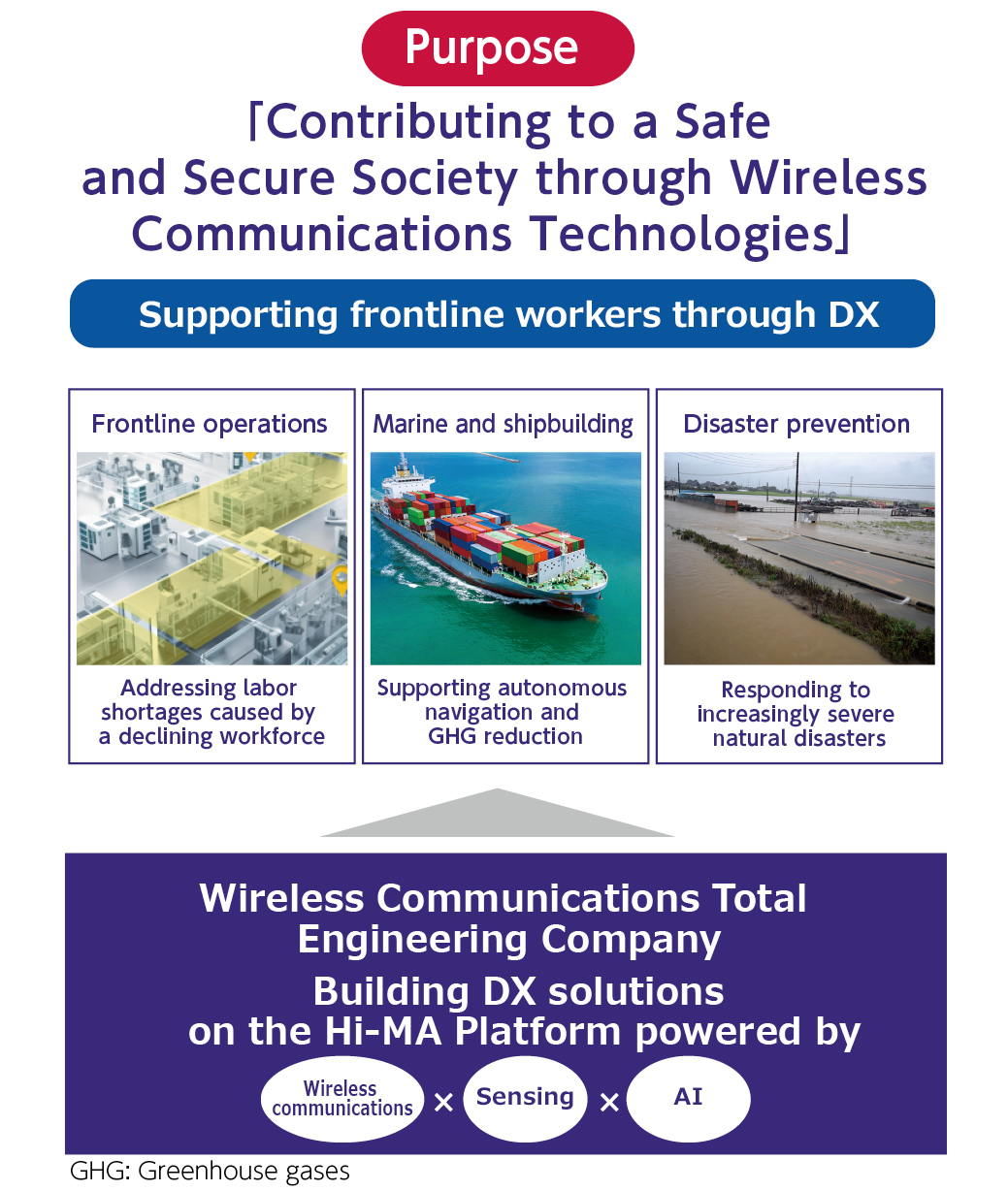
■ Our Purpose: Contributing to a Safe and Secure Society through Wireless Communications Technologies
As a Wireless Communications Total Engineering Company, we support frontline workers through DX solutions powered by wireless communications, sensing, and AI, helping solve social challenges while contributing to a safer and more secure society. Guided by this vision, we will continue strengthening our technology foundation.
■ Creating New Businesses through the Integration of R&D Across Three Core Operating Companies
By integrating the R&D capabilities of Japan Radio Co., Ltd., KOKUSAI DENKI Electric Inc., and Nisshinbo Micro Devices Inc., we will create new businesses that fulfill the purpose of the Wireless and Communications business. Leveraging the technological strengths of each company, the FI Division, operating companies, and frontline operations will work closely together to strengthen the competitiveness of our existing businesses while simultaneously expanding into new business domains.
Integrated Three-Party Framework
■ Current Challenges (Before)
In our fiscal 2025 report, we outlined an approach that combined backcasting from a vision of the future society with forecasting by our operating companies. However, R&D, business units, and frontline operations were still functioning independently, and the organizational framework to translate research outcomes into business value was insufficient.
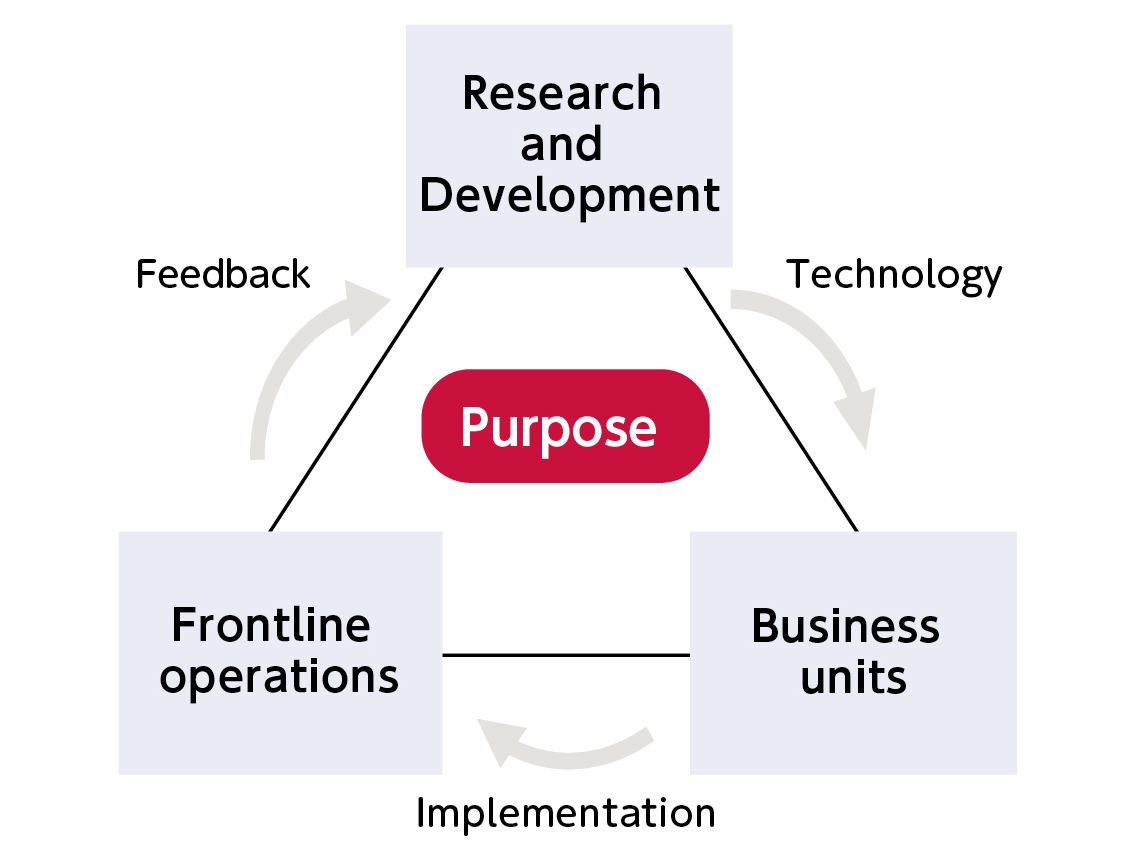
■ Our New Framework (After)
Our new framework places our purpose at the center of collaboration among R&D, business units, and frontline operations, creating a continuous cycle of value creation. Technologies developed through R&D in response to customer challenges are transferred to the business units and implemented in the field to solve those challenges. Practical knowledge and feedback gained through field implementation are then fed back into R&D, improving the accuracy and effectiveness of future technology development. Through this cycle, we will fulfill our purpose of contributing to a safe and secure society through wireless communications technologies while continuously creating business value.
Putting the Integrated Three-Party Framework into Practice through the Long-Term Technology Plan
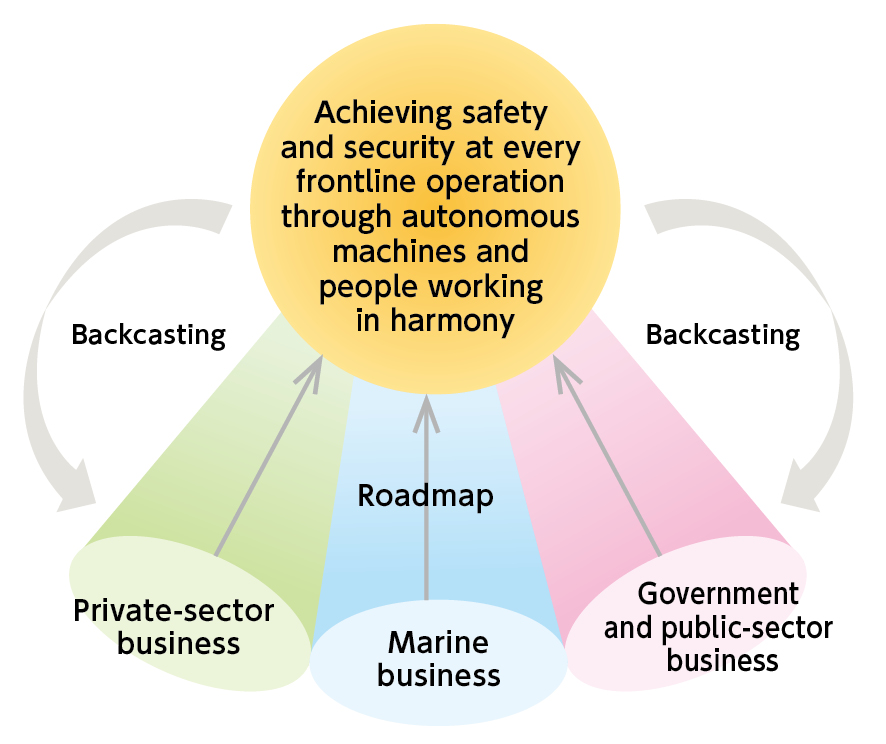
■ Implementing the Seven Perspectives
〈Our R&D Focus〉
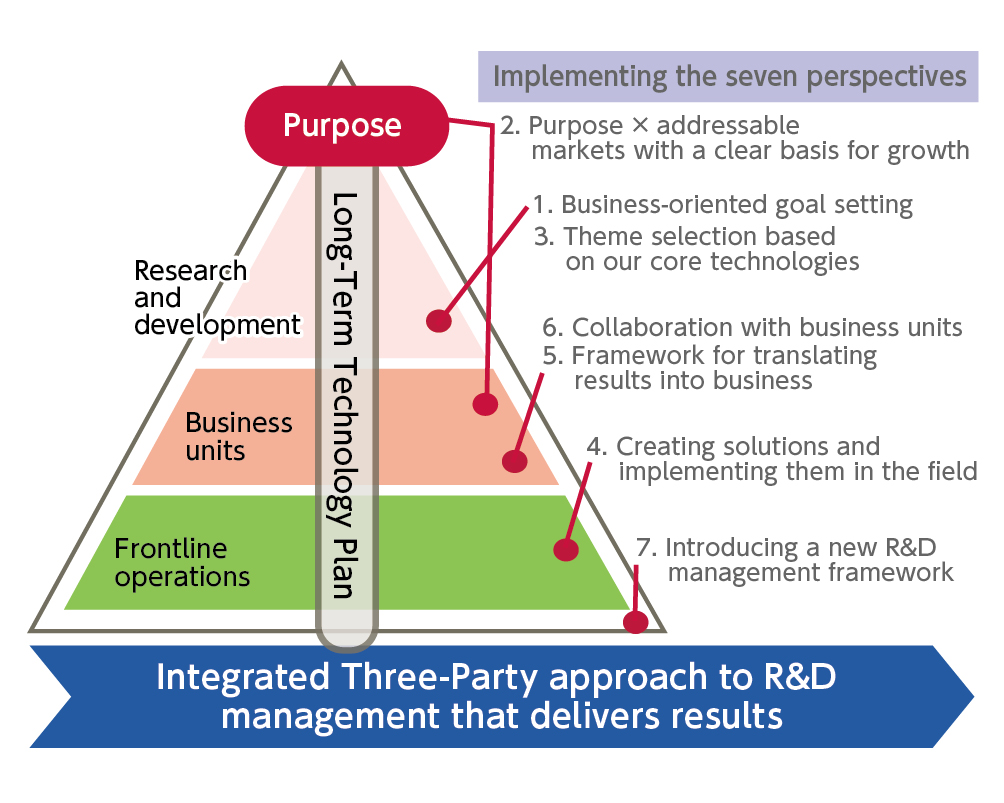
1. Business-oriented goal setting
2. Purpose × addressable markets with a clear basis for growth
3. Theme selection based on our core technologies
─ We establish business-oriented objectives by combining the social challenges derived from our purpose with our core technologies in wireless communications, sensing, and AI, focusing on markets with sustainable growth potential.
〈How We Translate R&D Outcomes into Business Value〉
4. Creating solutions and implementing them in the field
5. Framework for translating results into business
6. Collaboration with business units
─ From the research stage onward, business units and frontline operations participate together, enabling seamless progression from Customer Zero/One demonstrations through commercialization.
〈Transforming R&D Management〉
7. Introducing a new R&D management framework
─ We will shift from technology-driven R&D to business-oriented R&D and establish results-driven R&D management that designs research with business creation and business expansion in mind.
■ Long-Term Technology Plan: Putting the Integrated Three-Party Framework into Practice
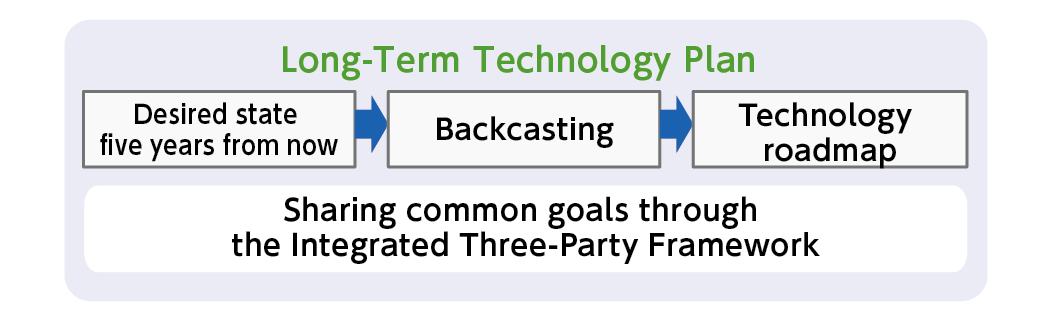
The foundation of our new R&D management framework is the Long-Term Technology Plan. Members from R&D, business units, and frontline operations come together in integrated Three-Party Framework workshops to develop technology roadmaps by backcasting from the desired state five years into the future.
■ An Evolving Framework
The forecasting and backcasting concept introduced in fiscal 2025 has evolved into a framework in which the two are structurally integrated through the Long-Term Technology Plan. By providing a common foundation, the Long-Term Technology Plan enables all participants to share a common vision of the desired future and common objectives while developing technology roadmaps to achieve them. This framework allows business creation, business expansion, and profit generation to be pursued simultaneously.
■ Implementing the Seven Perspectives
〈Our R&D Focus〉
1. Business-oriented goal setting
2. Purpose × addressable markets with a clear basis for growth
3. Theme selection based on our core technologies
─ We establish business-oriented objectives by combining the social challenges derived from our purpose with our core technologies in wireless communications, sensing, and AI, focusing on markets with sustainable growth potential.
〈How We Translate R&D Outcomes into Business Value〉
4. Creating solutions and implementing them in the field
5. Framework for translating results into business
6. Collaboration with business units
─ From the research stage onward, business units and frontline operations participate together, enabling seamless progression from Customer Zero/One demonstrations through commercialization.
〈Transforming R&D Management〉
7. Introducing a new R&D management framework
─ We will shift from technology-driven R&D to business-oriented R&D and establish results-driven R&D management that designs research with business creation and business expansion in mind.
■ Long-Term Technology Plan: Putting the Integrated Three-Party Framework into Practice
The foundation of our new R&D management framework is the Long-Term Technology Plan. Members from R&D, business units, and frontline operations come together in integrated Three-Party Framework workshops to develop technology roadmaps by backcasting from the desired state five years into the future.
■ An Evolving Framework
The forecasting and backcasting concept introduced in fiscal 2025 has evolved into a framework in which the two are structurally integrated through the Long-Term Technology Plan. By providing a common foundation, the Long-Term Technology Plan enables all participants to share a common vision of the desired future and common objectives while developing technology roadmaps to achieve them. This framework allows business creation, business expansion, and profit generation to be pursued simultaneously.
Research Themes

■ Theme 1: Smart Factory
We will accelerate growth in the private-sector business by implementing products and services in our own factories as Customer Zero. By combining wireless communications, sensing, AI, and mechatronics through Physical AI, we will provide end-to-end solutions ranging from situational awareness to automation. Through implementation, verification, and continuous improvement within our own operations, we will drive practical solutions to customer challenges.
■ Theme 2: Smart Ship
Working collaboratively with customers, we will progressively expand the value we provide and advance the Marine Business through autonomous navigation services developed from customer co-creation frontline sites. By integrating data science with our core technologies in wireless communications, sensing, and AI, we will deliver services that enable more advanced vessel operations and greater automation.
■ Theme 3: Disaster Information Platform
We will develop services by leveraging our established presence in the government and public sector. By implementing our existing assets on the Hi-MA Platform, we will expand service offerings. Leveraging our core technologies in wireless communications, sensing, and AI, we will enhance information collection and analysis and use data more effectively to expand the value we provide beyond disaster response to include support for regional revitalization during ordinary times.
(Source: Integrated Report 2026)