

The Nisshinbo Group's mission is to “contribute to society through our business activities,” and we have been conducting our business operations with respect for human rights.
As the importance of respecting human rights has increased further following the adoption of the United Nations Guiding Principles on Business and Human Rights in 2011, we have once again deeply recognized our responsibility as a company to respect human rights.
In August 2023, we established the “Nisshinbo Group Human Rights Statement” to express our commitment to respecting human rights.
This statement serves as the overarching statement for all documents and norms related to the Nisshinbo Group's efforts to respect human rights in its business activities.
We are committed to respecting, protecting, and promoting the human rights of not only our employees but also those of our customers, business partners, local communities, and all other individuals with whom we interact. We will manage our business with respect for human rights through human rights due diligence. We will strive to realize the well-being of society in which people living today and children who will live in the future can each lead happy and fulfilling lives.
Initiatives for 2025
Establishment and Strengthening of Grievance Mechanisms
In fiscal 2025, we focused on grievance mechanisms, which serve as a critical foundation for enhancing the effectiveness of human rights due diligence, and conducted an internal survey to assess the status of their establishment and operation across our Group companies. The purpose of this survey was to identify and assess gaps in the current state of grievance mechanisms at each Group company against the requirements outlined in the UN Guiding Principles on Business and Human Rights, and to use the findings for further improvements and enhancements.
In conducting the survey, we designed our survey questions based on the evaluation criteria published by the Corporate Human Rights Benchmark (CHRB), an international human rights assessment organization.
Eight effectiveness criteria under the UN Guiding Principles on Business and Human Rights:
-
Legitimate
-
Accessible
-
Predictable
-
Equitable
-
Transparent
-
Rights-compatible
-
A source of continuous learning
-
Based on engagement and dialogue
Survey Overview
-
Scope:
34 domestic and overseas Group companies that have established their own grievance mechanisms
-
Period:
September to December 2025
-
Method:
Questionnaires and interviews with personnel in charge
-
Items:
32 questions across 8 criteria, independently designed based on CHRB standards
Results
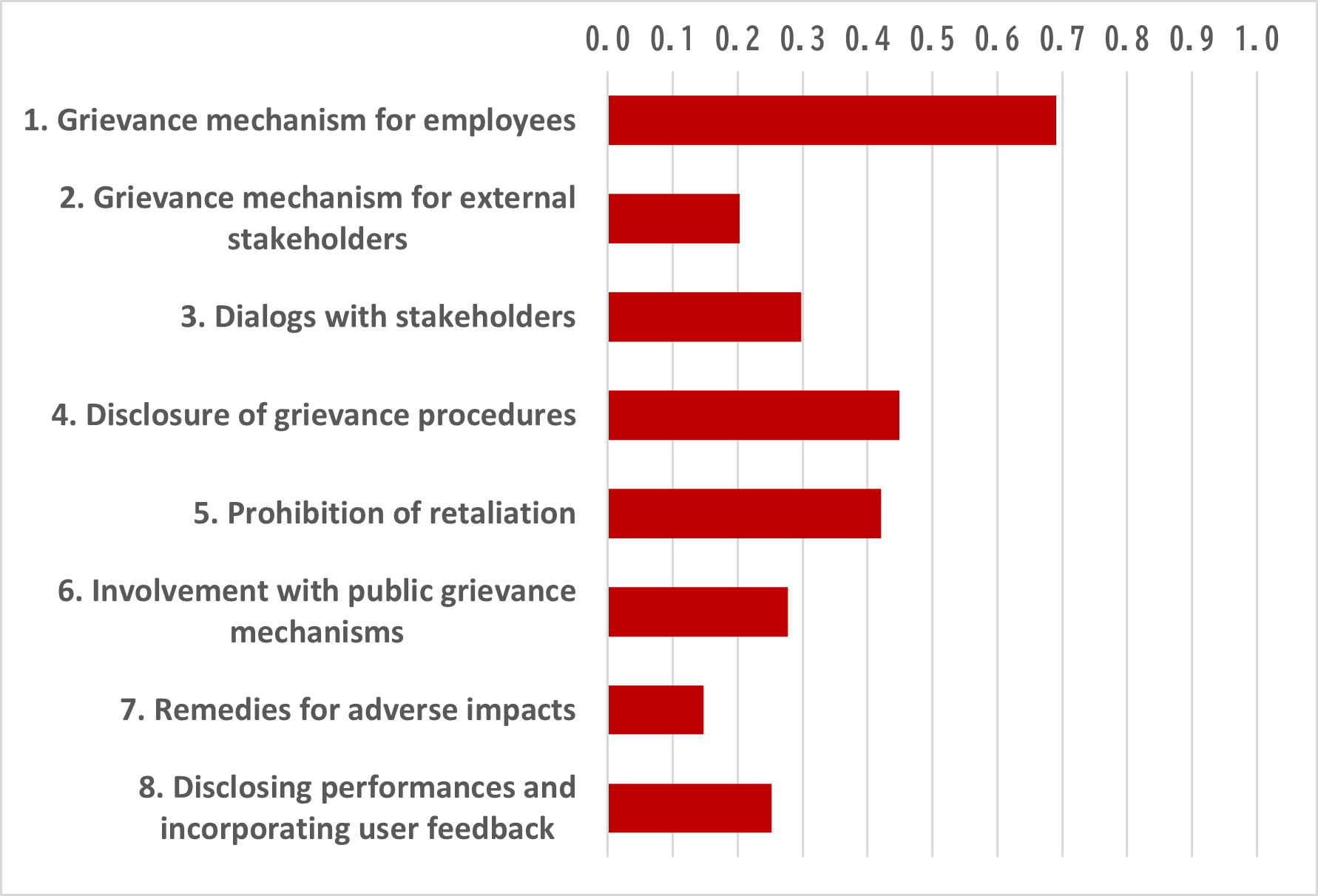
Each of the eight criteria was scored on an eight-point scale, resulting in an overall average score of 2.7, indicating room for improvement. While no major issues were identified in day-to-day operations, several challenges were identified. These include the documentation of rules and procedures, communication and awareness among users, and internal and external disclosure.
Analysis and Measures
-
Grievance mechanism for employees:
Due to insufficient multilingual support, not all employees are guaranteed access to grievance channels. We will enhance multilingual support to establish grievance mechanisms accessible to all workers.
-
Grievance mechanism for external stakeholders:
While multilingual support has been partially implemented, awareness of the grievance mechanism among external stakeholders and business partners remains insufficient. We will enhance awareness and promote usage through training and dissemination of guidelines.
-
Dialog with stakeholders:
User feedback is not sufficiently reflected in the design and improvement of grievance mechanisms. Through regular dialogue with stakeholders, we will establish mechanisms to incorporate their feedback into operational improvements.
-
Disclosure of grievance procedures:
Although grievance procedures are in place, complainants are not adequately informed about types of outcomes they can expect. We will disclose types of outcomes and expected timelines for different stages of the grievance process to enhance the credibility of our grievance mechanisms.
-
Prohibition of retaliation:
While a policy prohibiting retaliation is in place, its documentation, disclosure, and regular monitoring are insufficient. We will clearly document and disclose our non-retaliation policy and strengthen monitoring of compliance with this policy.
-
Involvement with public grievance mechanisms:
Company policies and rules regarding engagement with public grievance mechanisms are not clearly defined. We will formalize policies that ensure complainants’ legal rights to access public mechanisms and communicate these policies internally and externally.
-
Remedies for adverse impacts:
Disclosure of grievance procedures, types of remedies available, and measures to prevent recurrence is insufficient. We will enhance disclosure in accordance with the Guiding Principles.
-
Disclosing performance and incorporating user feedback:
While insights gained from grievance handling are utilized to enhance the company’s human rights initiatives, information on the performance of our grievance mechanisms is not sufficiently disclosed. We will progressively disclose available data, including the number of cases handled.
Future Actions
This survey has clearly identified the starting point for improvements toward the desired state. Accordingly, we will focus on establishing and strengthening our grievance mechanisms as outlined below.
- Strengthening the capabilities of grievance officers
- We will renew training programs for domestic grievance mechanisms and provide training for both domestic and overseas officers to convey the importance of grievance mechanisms, while supporting the development and improvement of these mechanisms through dialogue.
- Establishment of grievance procedures and rules
- In addition to compliance with applicable domestic laws and regulations, we will further develop our guidelines and rules in line with the UN Guiding Principles on Business and Human Rights.
- Dialogue with grievance mechanism users
- In developing grievance mechanisms, we will create opportunities for dialogue with users and incorporate their feedback into the design and improvement of the mechanisms.
- Enhancing awareness and accessibility of grievance mechanisms
- We will promote greater use of grievance mechanisms and improve accessibility by strengthening awareness initiatives and expanding multilingual support.
- Requests to business partners
- Through procurement questionnaires and the dissemination of procurement guidelines, we will request Group companies to encourage their business partners to establish grievance mechanisms.
- Disclosure of relevant information
- We will disclose information on the handling of grievances, expected outcomes, and operational improvements both internally and externally to enhance the transparency and credibility of our grievance mechanisms.
Development of a Responsible Mineral Sourcing Framework
With growing awareness of human rights issues, regulations are expected to expand beyond conflict minerals such as 3TG (tin, tantalum, tungsten, and gold) to encompass a broader range of minerals and regions. Accordingly, we consider responsible mineral procurement to be a key component of our human rights due diligence. In fiscal 2025, we conducted interviews with procurement personnel at our operating companies regarding Conflict Minerals (CM), Extended Minerals (EM), and Additional Minerals (AM) to assess the current situation.
For Group companies that use CM and EM, we confirmed that appropriate measures are in place, such as submitting standardized reporting templates to customers to investigate and report mineral usage across the supply chain. We will continue to enhance our mineral procurement framework through company-wide information sharing and ongoing dialogue with procurement personnel.
Education and Awareness-Raising Activities to Promote Understanding of Respect for Human Rights (Including Overseas)
We believe that a fundamental understanding of the corporate responsibility to respect human rights (Business and Human Rights) is necessary to promote effective human rights due diligence. In fiscal 2025, we conducted Group-wide training centered on the following two programs:
Group-wide Human Rights Training
As part of our annual Group-wide Human Rights Training, President Ishii delivered a message on human rights across the entire Group in fiscal 2025. By having the President personally address the importance of respecting human rights, we clearly demonstrated the commitment of top management. This training will be incorporated into our onboarding program for new employees.
Human Rights Training for Top Management
As part of our annual executive training, we held a lecture by Mr. Kazuo Tase, CEO of SDG Partners, Inc., titled “The Inseparable Relationship between Environment and Human Rights.” The lecture addressed shared issues and challenges by taking an integrated approach to environment and human rights, and provided practical insights for building pathways toward sustainable management and value creation across the entire supply chain. Approximately 800 participants attended, including executives and managers across the Group. We will continue to conduct training on themes that deepen the understanding of human rights among top management.
Future Plans
From 2026 onwards, we will further advance our human rights due diligence initiatives, focusing on:
-
Identification and mitigation of human rights risks
-
Dissemination of human rights-related guidelines
-
Establishment and strengthening of grievance mechanisms
-
Development of a Responsible Mineral Sourcing Framework
-
Education to promote understanding of respect for human rights (including overseas)